
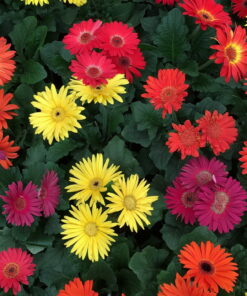
 Gerbera Seeds - Mix F1 (1000 seeds, Mix Color, Proprietary F1 Hybrid)


Fruit Vegetable Seeds
Yellow Chili Pepper Seeds – Yellow Hungarian Hot (Page’s Seeds, Heirloom Variety, 800 mg)
About the Vegetable Seed Collection
We recognize that there is no single definition of the “right” vegetable seed. Vegetable seeds can differ considerably in their characteristics and intended use. Depending on the crop and variety, growers may be looking for differences in how a plant grows, when it matures, what it produces and how the harvest is used.
Our collection is therefore deliberately built with varietal diversity in mind, bringing together different crops and varieties selected to address different growing and end-use requirements. This includes varieties for Home & Kitchen Gardening, open-field cultivation, Commercial Farming, Greenhouse Production and other protected growing environments, as well as varieties offering differences in taste, culinary use, texture, colour, shape and intensity.
This approach allows you, as a grower, to look beyond the crop itself and consider the characteristics that matter for your particular growing conditions, production objectives and desired results.
Vegetable Seed Categories
For your convenience, our vegetable seed collection is organized into five broad, intuitive groups, making it easy to browse and find the type of vegetable seeds you are looking for.
Flower Vegetables
Vegetables in which the edible flower or flower head is the primary harvested part, including broccoli and cauliflower.
Fruit Vegetables
Vegetables in which the fruit is the primary harvested part, including tomatoes, peppers, eggplant, cucumber and other fruiting crops.
Leafy & Salad Greens
Vegetables grown primarily for their edible leaves and leafy portions, including lettuce, cabbage, spinach, mustard, cooking greens and other leafy vegetables.
Legumes & Pods
Vegetable crops producing edible seeds or pods, including peas, beans and other leguminous vegetables.
Root & Bulb Vegetables
Vegetables harvested primarily for their underground roots, bulbs or related storage organs, including carrot, radish, beetroot, turnip, onion, garlic and similar crops.
Seed Classification: OP vs F1
Vegetable seeds are commonly available as Open-Pollinated (OP) or F1 Hybrid varieties based on how they are developed and reproduced.
Open-Pollinated seeds are varieties that reproduce through natural pollination and can retain their characteristic qualities from one generation to the next, although some natural variation may occur. This makes OP varieties suitable for growers
- who wish to preserve the traditional characteristics of a variety
- who wish to save seed for future planting
F1 Hybrid varieties are produced by crossing selected parent lines to combine specific characteristics in the resulting first-generation (F1) hybrids. F1 plants can offer desirable combinations of traits such as uniformity, maturity, yield, fruit quality, or disease resistance. Seeds saved from F1 Hybrids do not reliably reproduce the same combination of traits in the next generation. Consequently, growers generally need to source fresh F1 seeds for each new crop cycle when they want to reproduce the original F1 characteristics.
Some OP varieties are also described as Heirloom, referring to varieties that have been preserved and passed down through generations, retaining distinctive characteristics associated with older varieties. These characteristics may include traditional flavours, colours, shapes, textures and other natural varietal traits, making heirloom varieties particularly interesting to growers seeking traditional or distinctive vegetable varieties.
If you are interested in learning more about OP vs F1 classification and the associated terminology used to describe vegetable varieties, head over to our Knowledge Base article “Understanding Seed Classification & Terminology”, where we explain these distinctions and related terms in greater detail.
What Makes Vegetable Varieties Different and Why It Matters
Two varieties of the same vegetable can differ considerably in how they grow, when they mature, what they produce and how their harvest is used. As a result, choosing a vegetable seed is not simply about choosing the crop itself. The variety can be just as important, depending on where and how it will be grown, when the harvest is required and what the produce is intended for.
Different Growing Environments
Vegetables are grown in a wide range of environments, and the requirements of the grower can change accordingly. A variety that works well for a Home & Kitchen Garden may have different characteristics from one selected for Commercial Farming or Greenhouse & Protected Cultivation.
Home & Kitchen Gardens — growers may look for manageable plants, suitable maturity periods and produce that matches household preferences and intended use.
Containers & Small Spaces — compact or manageable plant habits, space requirements and suitable crop duration can become more important.
Open-Field Cultivation — seasonal suitability, temperature tolerance, disease resistance or tolerance, plant habit and yield potential may influence variety selection.
Commercial Farming — yield potential, uniformity, maturity period, disease resistance or tolerance, harvest characteristics and market requirements can all play a role.
Greenhouse & Protected Cultivation — varieties may be selected according to their suitability for the particular protected growing system, including considerations such as plant habit, maturity, temperature response, disease resistance or tolerance and production potential.
Different Harvest Timing & Production Objectives
Varieties can also differ in how quickly they reach maturity and the characteristics of the crop they produce at harvest. This gives growers greater flexibility when planning when and how a crop will be harvested.
- Different maturity periods early-, mid- and later-maturing varieties can provide different harvest windows and allow growers to plan production around their planting schedules and objectives.
-
Commercial growers can consider maturity and harvest timing alongside planting schedules, production cycles and market requirements.
-
Different production objectives may place greater importance on yield, uniformity, crop quality, harvest timing or particular market and end-use requirements.
Having varieties with different maturity periods can therefore give growers greater flexibility in planning production rather than treating all varieties of the same vegetable as interchangeable.
Our vegetable seed collection includes multiple varieties of several important crops, giving growers the opportunity to consider these differences when selecting seeds. Depending on the crop and variety, the characteristics that may be relevant can be broadly considered in two groups:
Growing & Production Characteristics
These characteristics relate primarily to how a variety grows and performs during cultivation and production:
-
Maturity period — how quickly a variety reaches harvestable maturity.
-
Plant habit — the plant's size, structure and growth pattern.
-
Yield potential — the quantity of produce a variety may be capable of producing under suitable growing conditions.
-
Uniformity — the consistency of plant growth and harvested produce.
-
Disease resistance or tolerance — the variety's ability to withstand or tolerate particular diseases.
-
Heat or cold tolerance — suitability for particular temperature conditions.
-
Seasonal suitability — how well a variety fits particular growing periods and climatic conditions.
-
Harvest characteristics — characteristics of the crop at the stage when it is harvested.
Culinary & End-Use Characteristics
These characteristics relate primarily to the qualities of the harvested vegetable and how it is intended to be used:
-
Size and shape — the dimensions and form of the harvested vegetable.
-
Colour — the colour of the fruit, root, leaf, bulb or other harvested part.
-
Flavour and taste — differences ranging from mild or sweet to stronger or more distinctive flavours.
-
Texture — differences in firmness, crispness, tenderness or other textural qualities.
-
Intensity or strength — particularly relevant to crops such as peppers, where varieties can differ substantially in pungency.
-
Culinary or end use — suitability for fresh consumption, cooking, processing, preservation or other intended uses.
Understanding these differences allows growers to look beyond the crop name and select varieties according to their growing conditions, production objectives, desired harvest timing and intended use.
Vegetable Seed Sources & Brands
BAGH.PK brings together vegetable seeds from well-reputed international commercial brands, recognized local seed suppliers and distribution channels, and specialty seed brands. This sourcing network allows our collection to combine broadly used commercial varieties, locally available seed lines and targeted specialty varieties, covering different crops, growing environments and end uses.
International Commercial Brands
International commercial seed companies develop and supply a broad range of vegetable varieties for professional horticultural and agricultural production, including varieties widely used across commercial growing systems and markets. Their breeding programmes address characteristics such as maturity, yield potential, uniformity, disease resistance and crop quality, providing the broad commercial foundation of our vegetable seed collection.
We offer varieties from the following established international commercial seed companies, with additional brands and varieties potentially being incorporated into our collection over time:
- Syngenta
- Takii
- East-West Seed
- Known-You Seed
- Hem Zaden
- Arrow Seeds
- Nongwoo Bio
Local Seed Suppliers & Distribution Channels
Local seed suppliers and distribution channels play an important role in making both international and locally developed vegetable varieties available to growers in Pakistan. Some also offer their own branded varieties, providing an additional source of seeds suited to the local market.
We work with the following well-reputed and well-recognized local seed suppliers and distribution channels:
- Haji Sons
- Rachna Seeds
- MDS (Mehr Muhammad Dins & Sons)
Specialty Seed Brands
Specialty seed brands complement our commercial range with more targeted varieties, including heirlooms and selections with particular culinary or historical appeal.
- Livingston Seed — a long-established American seed brand with a strong heritage in vegetable seed and tomato breeding, particularly serving home gardeners and small farming operations. Its catalogue includes heirlooms and less-common varieties valued for their flavour, colour, shape, size and other culinary characteristics.
- Johnny's Selected Seeds — a specialist American seed company with a strong emphasis on flavour and eating quality, offering vegetable varieties with carefully evaluated culinary characteristics such as taste, colour, shape, size and texture. Johnny's also maintains and is recognized for stringent germination standards.
The combination of broad commercial brands, established local sourcing channels and targeted specialty seed brands allows us to serve a wide range of growers and growing needs, from mainstream vegetable production to home gardening, small-scale farming and more specialized varietal interests.
Growing Seasons in Pakistan
Pakistan's diverse climate allows a wide range of vegetables to be grown across different seasons and regions. For vegetable growers, understanding seasonal temperature patterns is important because different crops and varieties have different temperature requirements for germination, vegetative growth, flowering and fruit or root development.
Cool-season vegetables generally perform best under cooler conditions and are commonly grown during autumn and winter. These include crops such as carrot, radish, beetroot, peas, cabbage, cauliflower, broccoli, lettuce, spinach and other leafy greens.
Warm-season vegetables prefer warmer growing conditions and are generally grown during spring, with a second growing window for some crops beginning in early autumn. Crops such as tomato, pepper, eggplant, cucumber, okra and many other warm-season vegetables can be grown during suitable periods within these warmer conditions.
The exact growing season can vary considerably according to crop, variety, location, local climate and growing system. Greenhouse and other protected cultivation systems can further extend or modify the normal outdoor growing window.
For detailed information on vegetable growing seasons, sowing times and crop-specific recommendations in Pakistan, explore our Learning Hub, where we provide more in-depth growing and farming guidance.